DUMBO vs. SoHo: Where Does New York’s Boldest Street Style Actually Live?

DUMBO vs. SoHo: Where Does New York’s Boldest Street Style Actually Live?
New York City’s street style has long been a global benchmark, but the epicenter of its boldest looks keeps shifting. Today, the debate often lands on two iconic neighborhoods: DUMBO in Brooklyn and SoHo in Manhattan. While both boast cobblestone streets, art-forward histories, and fashion-forward crowds, they cultivate distinctly different aesthetics. SoHo pulses with high-energy, trend-driven eclecticism, while DUMBO leans into polished minimalism and curated craftsmanship.
Historical Roots: From Industrial Grit to Fashion Frontier
SoHo: The Birthplace of American Streetwear
SoHo—short for “South of Houston Street”—emerged in the 1960s and 70s as a haven for artists fleeing rising Manhattan rents. They converted cast-iron industrial lofts into live-work studios, spawning galleries, performance spaces, and an underground creative scene that rejected conventional fashion norms. This artistic resistance became the DNA of SoHo style: fearless, experimental, and inherently rebellious. By the 1980s and 90s, the neighborhood had transformed into a shopping destination, but its street style retained that edge—a mix of high fashion, vintage finds, and downtown cool that continues to define American streetwear culture.
DUMBO: Brooklyn’s SoHo, But Different
DUMBO—Down Under the Manhattan Bridge Overpass—followed a similar trajectory, but with a crucial twist. In the 1970s and 80s, artists priced out of Manhattan discovered DUMBO’s cheap lofts, cobblestone streets, and waterfront views. Developer David Walentas envisioned a “SoHo-like neighborhood,” but intentionally avoided replicating SoHo’s mall-like retail saturation. Instead, DUMBO retained more local, independent businesses and a stronger residential core. While gentrification raised prices (today, DUMBO lofts often exceed Manhattan equivalents), the neighborhood preserved a quieter, more design-conscious vibe. Where SoHo became a global fashion runway, DUMBO evolved into a polished, minimalist enclave—Brooklyn’s answer to SoHo, but with less chaos and more intentionality.
The Aesthetic Divide: Polished Minimalism vs. Eclectic Rebellion
DUMBO: Refined, Timeless, and Design-Forward
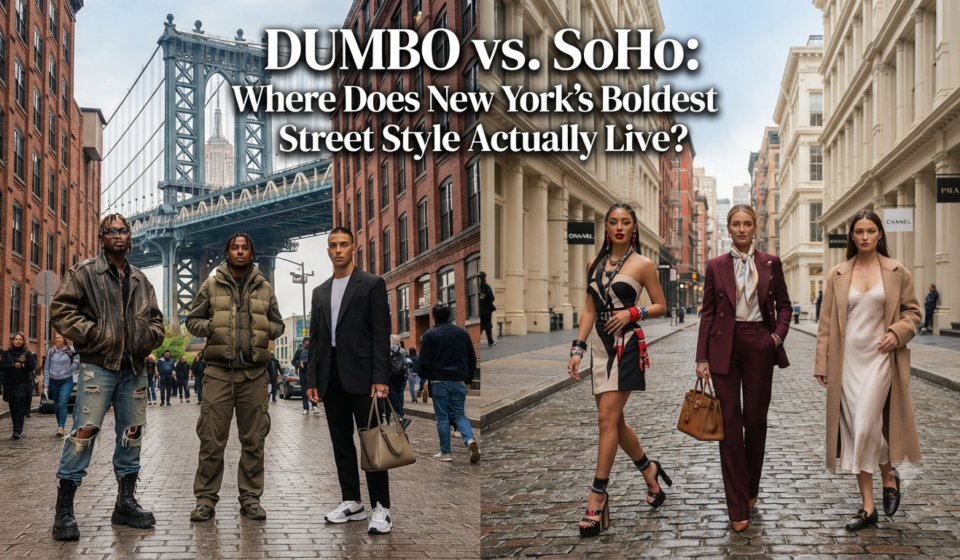
DUMBO’s street style mirrors its architecture: clean lines, red-brick textures, and breathtaking Manhattan views. The aesthetic is polished and minimalist, prioritizing investment pieces, impeccable craftsmanship, and timeless silhouettes. Think tailored coats, neutral palettes, high-quality denim, and understated accessories. Vintage shopping in DUMBO—especially at the Brooklyn Flea under the Manhattan Bridge archway—leans toward curated Japanese Americana, luxury archives, and “trendy” secondhand designer goods treated with museum-level respect. The vibe is less about standing out and more about standing for quality: a quiet confidence that says, “I know what good design looks like.”
SoHo: Bold, Layered, and Unapologetically Extra
SoHo, by contrast, is a fashion laboratory where rules dissolve. Its street style is a high-low collision: luxury boutiques (Dior, Celine, Prada) sit steps from vintage racks, streetwear drops, and indie designers. The result is maximalist eclecticism—oversized layers, sweat sets paired with heels, vintage band tees under blazers, and statement accessories that demand attention. SoHo style isn’t just clothing; it’s a mindset born from decades of artistic innovation and resistance. Here, fashion is performance, and the street is the runway. The neighborhood’s energy—tourists, influencers, models, and creatives—amplifies this, making SoHo feel like a perpetual fashion week.
Shopping Scenes: Curated Boutiques vs. Endless Options
DUMBO: Quality Over Quantity
DUMBO’s retail landscape is intentionally sparse. Boutiques are few but exceptional, focusing on independent designers, minimalist aesthetics, and locally owned enterprises. Stores like Natural Selection (handcrafted lifestyle and fashion) and Glasgow shirt specialists emphasize artisanal technique and attention to detail. The Brooklyn Flea, running April through December, offers vintage luxury and one-of-a-kind finds, but even here, curation is key—vendors treat secondhand clothing as collectible art. DUMBO isn’t a destination for endless browsing; it’s for intentional purchases from brands that align with a refined, sustainable ethos.
SoHo: A Shopper’s Paradise
SoHo is the opposite: a dense, dazzling grid of options. Broadway anchors the scene with flagship stores (Bloomingdale’s, H&M, Urban Outfitters), while side streets hide indie boutiques, jewelry studios, and luxury houses (Bottega Veneta, Tibi, Kate Spade). The mix is deliberate: high-street meets high-fashion, vintage meets avant-garde. Fashion experts like stylist Erin Walsh call SoHo “teeming with so many options,” citing The Webster, Chloé, and countless independent labels. This abundance fuels SoHo’s street style: with endless combinations available, experimentation becomes the norm.
The People: Who Wears What, and Why
DUMBO: Creatives, Tech Workers, and Quiet Connoisseurs
DUMBO’s residents and visitors skew toward tech professionals, digital creatives, and affluent families seeking a calmer alternative to Manhattan. The street style reflects this: functional elegance, work-appropriate minimalism, and weekend-ready neutrals. It’s a crowd that values sustainability, craftsmanship, and subtlety—people who might spend $400 on a perfectly cut shirt but won’t logo it. Even the neighborhood’s events—street fairs, live music, art exhibitions under the DUMBO Archway—feel curated and community-focused, reinforcing a style that’s inclusive but never loud.
SoHo: Influencers, Models, and Fashion Risk-Takers
SoHo draws a different crowd: influencers documenting outfits, models between castings, tourists hunting designer deals, and downtown creatives pushing boundaries. The street style here is performative and aspirational—a visual language of status, trend-awareness, and individuality. It’s where you’ll see sweatpants styled with Birkins, vintage band tees under Balenciaga blazers, and sneakers that cost more than rent. This isn’t accidental; SoHo’s history as an artistic frontier encourages fashion as self-expression, and its global reputation attracts those who want to be seen.
The Verdict: Boldness Redefined
So the question—where does New York’s boldest street style actually live?—depends on how you define “bold.”
If boldness means volume, variety, and visual impact, SoHo wins decisively. Its streets are a cacophony of trends, luxury logos, vintage rarities, and streetwear drops. The energy is electric, the options endless, and the fashion is unapologetically extra. SoHo is where fashion goes to be seen, and its street style reflects that spectacle.
But if boldness means confidence in restraint, commitment to quality, and quiet innovation, DUMBO takes the crown. Its minimalism isn’t timid; it’s deliberate. Every piece is chosen with intention, every silhouette speaks to craftsmanship over hype. In a city obsessed with novelty, DUMBO’s boldness lies in its refusal to chase trends—a radical act of design integrity.
Ultimately, both neighborhoods embody New York’s fashion soul, just in different dialects. SoHo shouts; DUMBO whispers. One is a runway, the other a gallery. And that tension—between spectacle and subtlety, abundance and curation, rebellion and refinement—is what makes New York’s street style endlessly compelling.
For marketers, creatives, and fashion observers, the takeaway is clear: SoHo is where trends are born and amplified, while DUMBO is where they’re distilled and elevated. Together, they form a complete picture of New York’s boldest street style—not as a single location, but as a dynamic conversation between two iconic neighborhoods.