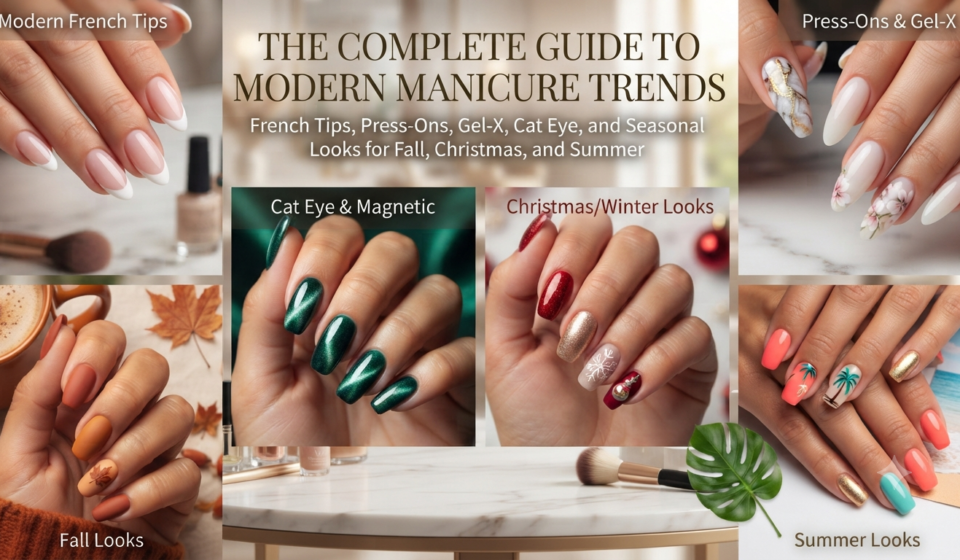
The Complete Guide to Modern Manicure Trends: French Tips, Press-Ons, Gel-X, Cat Eye, and the Seasonal Looks for Fall, Christmas, and Summer

Nail trends now move fast. A style can start in a Seoul salon, spread through short-form video in days, and end up in a drugstore aisle within a season. The manicure has also turned into a small wardrobe of its own. Many people now keep a classic French tip for work, a set of press-ons for a wedding weekend, a magnetic velvet finish for winter, and a jelly-bright color for July.
This guide covers seven pieces of that wardrobe: French tip nails, press-on nails, Gel-X extensions, cat eye nails, and the fall, Christmas, and summer looks that dominate the calendar. I researched current trend reports, manicurist commentary, and technical guides. I’ve flagged where sources disagree and where the “facts” come from companies with something to sell. The date is late September 2026, so fall is here and the holiday rush is a few weeks away.
Part One: French Tip Nails
An American Invention with a French Name
The French manicure is not French. Most accounts credit Jeff Pink, founder of the professional nail brand Orly, and say he created it in Hollywood in the 1970s to solve a studio problem: actresses shouldn’t need a new polish for every costume change. The idea was one neutral look that worked with everything on screen.
The exact date is fuzzy. One source says Pink began talking with film studios in 1976, created “The Natural Nail Look” in 1977, and saw it reach Paris runways in 1978, where the “French manicure” name took hold. Wikipedia’s manicure entry dates the invention to 1976, and other accounts say 1975. Treat the year as approximate, but the Hollywood origin is consistent across sources.
Pink has described the technique in simple terms. He was inspired by how a white pencil under the nail brightens it, and he applied the same idea to the top: white polish on the tips and a pink, beige, or rose shade on the nail.
A few sources trace the look to 1920s Paris or to Max Factor. That version is widely repeated but weaker than the Pink story, and I wouldn’t lean on it.
The look is now old enough to have its own preservation effort. Orly is leading a campaign around the manicure’s 50-year milestone, including a proposal for a French Manicure Day and a submission of the original Orly French Manicure Kit to the Smithsonian’s Personal Care and Cosmetics Collection. That is a brand promoting its own history, but it shows how established the style is.
How the Style Has Changed
The French manicure has been reinterpreted almost every decade. One nail-salon founder summarized it this way: it was iconic in the 90s with crisp white tips, square shapes, and high gloss, softened in the 2000s, and more recently the “clean girl” aesthetic brought sheer bases and ultra-fine micro tips to the front.
The formula is simple: a base color, a defined tip, and a nail shape. That structure allows endless variation. As one guide puts it, the base-plus-tip format lets you change color, shape, length, and finish while staying recognizably French.
French Tips in 2026
Current reporting shows French tips are popular again, not just surviving. Nail artists describe them as more popular now than in years, with celebrities swapping the plain white line for velvet finishes and buttery yellow tips. The same source names three drivers: the clean-girl look, quiet luxury, and nostalgia for the thick-tipped early-2000s version.
Here are the main variations to know:
The micro French. This is the thinnest line you can get, on a sheer or milky base. It suits short natural nails and office settings. A holiday variation from a recent trend roundup pairs a sheer pink or milky nude base with an ultra-thin champagne-gold tip, and suggests asking for the thinnest French line possible on an almost translucent base.
The colored French. Tips in any shade: cobalt, butter yellow, burgundy, forest green. A creamy cornflower shade is described as working equally well all over the nail or as an alternative French-tip color.
The double French. A second thin line sits just under the main tip. Sources describe colorful and double French tip manicures among the many current iterations.
The ombré or “blurred” French. The tip fades softly into the base. Orly describes ombré French as a softer, blended transition that suits people who find the stark contrast too severe.
The chrome or velvet French. The tip carries a mirror or magnetic finish. This is the bridge between French tips and cat eye nails, discussed below.
The short French. Shorter nails have been a major trend. The design works on short nails, often with a thinner white line to keep proportions right. If you wear short nails, choose a thinner line and a slightly curved smile line, because a thick band on a short nail can look stubby.
Getting It Right
Three decisions matter most for French tips:
- Tip width. One guide advises matching the tip width to your nail size and choosing a finish that fits the occasion. Thin lines read modern, and thick lines read nostalgic.
- Base color. The base should flatter your skin tone. A pinker base reads warmer, a beige base reads neutral, and a milky white base reads soft.
- Shape. Square tips give the classic 90s look. Almond and oval shapes give a more current, elongated effect. Squoval is the safe middle.
For DIYers, French tips are one of the hardest designs to do freehand. Guide stickers, tip guides, or pre-made press-ons are the practical workarounds. That leads to the next section.
Part Two: Press-On Nails
Why Press-Ons Have Changed
Press-on nails have lost much of their old reputation. Older versions were flimsy plastic with sticky tabs. Current versions come in many shapes, sizes, and finishes. One brand comparison says press-ons have evolved significantly and now mimic salon-quality nails in a wide range of shapes, colors, and designs.
Their biggest advantage is that the design is finished before you apply it. As one comparison notes, press-ons can change both the design and the visible architecture of the nail, adding length, creating a new shape, and delivering cat-eye, chrome, or detailed artwork immediately. A salon has to build those looks nail by nail. A press-on arrives with them done.
Wear Time: Tabs vs. Glue
Wear time depends mostly on the adhesive, and sources give different numbers. That is expected, because most of them are press-on sellers.
- Adhesive tabs: One brand says tabs give roughly one to three days and suit events. Another cites three to four days with gel pads.
- Nail glue: One manufacturer says seven to fourteen days is the standard range, and the high end requires proper prep, correct glue application, and avoiding prolonged water exposure. Another brand claims its glued sets last two to four weeks, matching gel. That is a bold claim from a seller, so I’d treat one to two weeks as a realistic planning number.
For comparison, gel manicures generally last two to three weeks with proper care. Gel usually wins on predictable longevity, and press-ons win on flexibility and speed.
Time and Cost
The time gap is significant. One retailer estimates a press-on set takes 10 to 15 minutes to apply, versus 45 to 90 minutes for DIY Gel-X and 60 to 120 minutes for a salon Gel-X visit. First-timers should expect more. One manufacturer says the 10 to 15 minute figure assumes some practice, and first-timers might take 20 to 25 minutes.
Cost claims vary widely by brand tier:
| Option | Reported cost | Source type |
|---|---|---|
| Budget-to-mid press-on set | $8–$15 per set | Manufacturer |
| Mid-range press-on set | $12–$25, reusable up to about 3 times | Retailer |
| Luxury press-on set | $25–$40 per set | Brand |
| Salon gel manicure | $40–$65 (one manufacturer citing an industry survey) or $45–$100+ (another brand) | Sellers |
| Salon Gel-X | $50–$90 (retailer) or $70–$100 with custom designs (brand) | Sellers |
Every figure here comes from a company that sells one side of the comparison, and regional pricing varies a lot. In a large city with a high-end salon, salon prices will be at the top of these ranges or beyond. Confirm with your own salon.
The cost logic is still sound. Press-ons cost less per application, especially if you wear them occasionally, and they usually have a lower starting cost than repeated professional gel appointments.
Nail Health
The health argument favors press-ons when they’re used correctly. One comparison notes that press-ons removed with a warm soapy soak leave natural nails intact, while Gel-X needs a file-down and acetone soak that can weaken nails over time. The key phrase is “removed correctly.” A different source puts it plainly: the key is gentle removal, never prying or forcing, plus a short rest between sets.
Prying off glued press-ons is the most common way people damage their nails. Peeling can take layers of the nail plate with it. If a glued set won’t budge, soak your fingertips longer in warm soapy water, or use an acetone-free press-on remover, and be patient.
Fit Is Everything
Fit determines whether a press-on looks expensive or cheap. A well-fitted set can look salon-finished, while an incorrect size can look bulky or leave visible gaps. Practical fit tips:
- Measure each nail, and expect your two hands to differ.
- Size up if you’re between sizes, then file the sides for a snug fit.
- Prep well: push back cuticles, lightly buff the shine, wipe with alcohol, and keep oils off the nail.
- Press from the cuticle end down, and hold for 30 seconds.
Who Should Choose Press-Ons?
Press-ons are best for:
- Event-driven manicures, such as a wedding, holiday party, or vacation.
- People who change their look often.
- People with short, soft, or damaged nails who want an instant result. One nail brand’s comparison says press-ons win on accessibility: short, soft, or damaged nails all get instant perfect nails.
- Anyone who wants to avoid UV lamps and acetone.
They’re less ideal for people with jobs that involve constant handwashing or manual work. Long press-ons also create more leverage, as one comparison notes, catching on objects more easily.
Part Three: Gel-X Nails
What Gel-X Is
“Gel-X” is often used as a generic term, but it’s a brand name. Aprés created the system, and while many brands now offer Gel-X-style extensions, Aprés was the original creator. The product is a set of pre-shaped, full-cover tips made of soft gel. Unlike a traditional acrylic set, there’s no sculpting with liquid and powder.
The tips are different from ordinary press-ons. Press-ons are finished artificial nails attached with tabs or glue, whereas Gel-X uses full-cover soft-gel tips bonded with a gel product cured under a compatible lamp. That difference in attachment is why Gel-X lasts longer and is harder to remove.
The tips cover the entire nail bed from cuticle to free edge, come in multiple sizes, and are available in shapes from short round to long coffin and stiletto. The system became popular through celebrity manicurists, and one celebrity nail artist described using Aprés extensions for red carpet events like the Met Gala.
How It’s Applied
The technique is fairly quick for an extension system. According to Aprés-related instructions:
- Prep the natural nail and apply a primer. Some newer adhesives skip this step.
- Apply a thin layer of Extend Gel to the natural nail and cure it for about 30 seconds.
- While the gel is still tacky, press on the tip and hold it, then cure again under the LED lamp.
- Shape and file, then apply color or nail art and a top coat.
Aprés promotes the idea that the adhesive gel is soak-off, flexible, and strong. Whether you find the system easy depends on your patience with sizing and curing, but the learning curve is friendlier than acrylic.
Wear Time and Cost
Sources generally agree that Gel-X lasts about three to four weeks: up to three to four weeks with proper care, and wearing gloves for chores helps prevent chipping and peeling. Others say two to four weeks depending on growth rate and care. A salon full set with art can cost more than a basic set. One handmade press-on brand says a full Gel-X set with nail art usually costs $80 to $120, plus the tip. An older Refinery29 piece says a full set costs upwards of $100 and takes at least an hour and a half in the salon. Prices have moved since then and vary by city, so use these as rough markers.
The Downsides
Gel-X is often marketed as gentle. It is gentler than some alternatives, but it isn’t damage-free.
- Removal takes time. Removal is similar to taking off gel polish: file off the top coat’s shine, apply acetone-soaked cotton wrapped in foil, wait 10 to 15 minutes, then scrape gently with a cuticle pusher.
- Forcing it off causes damage. One application guide says if the gel resists, re-soak for another five minutes and never force it. Any product that bonds to the nail can take nail layers with it when pulled off.
- Prep affects lifting. The same guide says early lifting is almost always a prep issue.
- It’s single-use. One press-on maker points out that Gel-X must be soaked off with acetone and can’t be reused. That is a fair environmental and cost point, even though it comes from a competitor.
The DIY Trend
Gel-X has moved from salons to home kits. A retailer’s May 2026 article claims DIY Gel-X is having a moment, with a May 2026 tutorial reaching 1.2 million views and search interest shifting away from salon gel. That is a retailer’s claim, so take it as directional. Still, DIY kits are clearly popular, and the same source estimates a starter kit runs $40 to $80, plus single-use tips at $1 to $3 each per finger per application.
If you try DIY Gel-X, invest in a proper LED lamp, prep carefully, and take your time with removal. The savings vanish quickly if you damage your nails and need months to regrow them.
Gel-X vs. Press-Ons: The Short Version
| Factor | Press-ons | Gel-X |
|---|---|---|
| Application | 10–25 minutes | 45–120 minutes |
| Wear time | Days to 2 weeks (glue) | 2–4 weeks |
| Reusable | Often 2–3 times | No |
| Removal | Warm soapy soak | Acetone soak |
| Curing lamp needed | No | Yes |
| Best for | Events, variety, budget | Long wear, low maintenance |
Choose by lifestyle. If you want a two-week vacation manicure that doesn’t need touching, Gel-X is more reliable. If you want a different look every weekend, press-ons are more practical.
Part Four: Cat Eye Nails
The Effect
Cat eye nails have a bright line of light that seems to shift as your hand moves, like the slit in a cat’s eye. The effect is more than a sparkle. It’s an optical trick. One explanation says where the magnetic particles concentrate the nail looks brighter and more reflective, and where they thin out the base color looks deeper, and that contrast creates the dimensional illusion.
How It Works
The polish contains tiny magnet-responsive particles suspended in gel. You hold a magnet over freshly applied gel to shift the particles into a pattern, then cure under a UV or LED lamp to lock the design in place. Timing is everything. One technical guide warns that if you cure before applying the magnet, nothing will happen because the particles are already trapped in random orientation.
Useful technique details from the guides:
- Use a proper nail magnet. One guide recommends a strong neodymium magnet, typically N52 grade, held 2 to 5 mm above the nail for 10 to 15 seconds, with closer giving a more concentrated effect and farther giving a softer one. Another says household magnets have weak or inconsistent fields and often produce a blurry, muddy design.
- Work one nail at a time. Particles naturally spread out again if you wait too long, so magnetize and flash-cure each nail for 60 seconds before moving on.
- Avoid curing on a metal surface. The same guide notes metal can pull at the particles during curing.
- Use a smooth base. A smooth base helps the effect look even.
- Use a dark base. A different guide reports that dark purple, midnight blue, and black are the most popular base colors because they make the stripe stand out.
Where It Came From
The story of cat eye polish’s origins is murky. One source says the effect started in the automotive industry, where it was used in car paint to create dynamic finishes, before being adapted for nail polish. Another, a manufacturer, says cat eye originated in Korean nail salons in 2014, and Korea still leads the trends. Both claims come from sellers and I couldn’t verify either independently, so treat them as plausible but unconfirmed.
Popular Cat Eye Styles
- Classic single stripe. One line, vertical or diagonal, on a deep base. It’s the beginner-friendly version: one coat, one pass with the magnet, cure.
- Velvet. A soft, diffuse shimmer across the whole nail. It’s the dominant look for fall and winter (see below).
- Aurora or duochrome. Aurora cat eye, a blue-purple duochrome, is described as one of the leading current styles.
- Halo. A ring of glow around the nail. Halo glow adds dimension.
- Cat eye French. A magnetic tip on a sheer base, combining two trends.
Almond and coffin shapes show the light stripe most dramatically, according to one guide. That’s a useful cue if you’re choosing a shape for a cat eye set.
Safety Notes
Two points matter. First, the polish is a gel system, so the usual cautions apply: avoid skin contact with uncured gel, since gel products are a known source of allergic contact dermatitis, and cure fully. Second, one guide answers the question of MRI wear bluntly: no, it’s not safe to wear cat eye polish during an MRI. Metallic particles and imaging magnets don’t mix. That claim comes from a nail brand, so it’s worth checking with your imaging facility, which will likely ask you to remove all polish anyway.
Cat eye finishes are also available on press-ons and Gel-X tips. A press-on comparison specifically lists cat-eye, chrome, or detailed artwork as finishes press-ons deliver immediately. If you don’t want to handle magnets, that’s the easy route.
Part Five: Fall Nails 2026
The Palette
Fall nail trends tend to deepen and desaturate. One celebrity manicurist described the pattern in a prior year’s coverage as nail color trends desaturating and deepening as leaves do. The 2026 season follows the pattern.
Brown, in every register. This is the season’s defining color. One trend report calls brown the season’s real neutral, running from milky caramel through cocoa to near-black espresso, warm and expensive-looking and easy to pair with what’s already in your closet. Brands agree: OPI’s fall guide highlights rich browns, vampy dark purples, earthy sage greens, and deep dark reds.
Wine, oxblood, and ruby. Red loyalists are trading bright cherry for depth: cabernet and wine-stained shades dark enough to read black in dim light. A more accessible variation is ruby: a ruby red that sits between deep burgundy and classic red is one of the more wearable fall colors.
Forest and olive green. A blogger’s fall roundup describes the current green as more woodsy than bright, reading almost as a neutral against fall clothes. OPI’s collection includes earthy sage and olive polishes, plus olive green chrome press-ons.
Smoky metallics. A celebrity manicurist quoted in Who What Wear predicts understated metallic shades such as soft pewter, rose gold, and brown chrome will dominate fall 2026.
The Finish: Depth Over Decoration
The most interesting shift this season is structural. One trend report says fall 2026 moved the interest from the top of the nail into it: where recent seasons stacked on charms, studs, and sculpted florals, current sets put the depth in the finish itself. Chrome and cat eye are central. Chrome goes warm in bronze, copper, and an oyster-shell pewter, plus magnetic cat eye in autumn colorways.
That matches the broader 2026 picture from Byrdie, which describes a more-is-more counter-current: rhinestone-heavy, charm-covered manicures, laser-thread nails, and mixed-metal charms over a matte neutral base. So fall offers two directions, quiet depth and maximalist jewelry, which you can choose between or combine.
Fall Sets Worth Trying
- Chocolate velvet cat eye. Brown magnetic gel on almond nails. This is the season’s central combination.
- Burgundy chrome. A wine base topped with chrome powder for a glassy finish.
- Milky caramel French. A milky beige base with a thin cocoa tip.
- The accent-leaf minimalist. One source describes three nails in deep glossy chocolate and one sheer nude accent nail with two small brown leaves and a scatter of gold flake, as a way to do a fall motif without going full theme.
- Forest green with gold. Deep green with a fine gold French line or foil.
For press-ons, fall is a strong season because the popular shades are dark, opaque, and forgiving of small imperfections. Darker colors also hide glue lines better than pale ones.
Part Six: Christmas Nails 2026
The Big Idea: Fashion, Not Clip Art
Holiday manicures used to mean obvious motifs like reindeer, snowflakes, and candy canes. Those still exist, but the trend reporting for 2026 points to something more refined. One roundup says holiday nails are getting more sophisticated, borrowing from fashion: velvet dresses, tartan coats, wrapped presents, fine jewelry, winter glass, and candlelit palettes, with intentional detail instead of piled-on Christmas motifs.
That logic also explains why some looks last longer. One editorial argues that trends that survive past the holidays are inspired by fashion, not by internet virality, and that texture is the difference this year, with velvet magnetic finishes creating depth without feeling flashy.
The Main Looks
Ruby velvet. The signature red of the year. The same roundup says if you need one red manicure to know, it’s ruby velvet, using a magnetic velvet or cat eye finish over a deep ruby, garnet, or cranberry base rather than a bright holiday red. This is where cat eye and Christmas nails overlap, and where press-ons or Gel-X with a magnetic finish are convenient.
Dark dahlia and plum-tinged reds. A nail brand’s holiday collection highlights a red with plum undertones as this year’s red, pairing it with velvet dresses and gold accessories. That’s a brand’s own color story, but it fits the broader shift toward darker reds.
Forest and emerald green. Green is repeatedly called out. One roundup says green is one of the hottest nail colors this year, and shimmering green glazed finishes give a festive feel. Another suggests deep forest greens with subtle botanical details can feel inspired by winter landscapes rather than holiday clichés.
Champagne-gold French tips. The quiet luxury option. A thin metallic tip over a sheer base suits dinners and office parties.
Bows. Tiny sculpted bows remain popular but grown-up. One roundup describes a rich burgundy, cranberry, or forest-green velvet base with a tiny sculpted bow on one or two nails. The “one or two nails” advice is the key. A bow on every nail can look childish.
Tartan and plaid. One editorial calls plaid one of the best examples of fashion inspiring beauty, drawn from scarves, tailored coats, and winter textiles.
Pearl and glazed finishes. For a softer take, pearl finishes offer less sparkle and more glow.
Playful and maximalist. Not everyone wants restraint. A more exuberant list describes red manicures with bows, gold French tips, and rhinestones, along with light-pink bow art for people who skip the traditional palette entirely. It also mentions a brown-and-blue combination trending for gingerbread nail art. Sweater nails also persist, with 3D cable-knit textures in red, cream, and forest green.
Practical Advice for December
- Book early. Salon appointments in the two weeks before Christmas fill up quickly. Many people schedule for the first or second week of December to keep the set fresh through the holidays.
- Match the length of the set to the season. A two-week manicure from early December will be growing out by New Year. A Gel-X set can last through both.
- Consider press-ons for one-night parties. If you have a single event, a press-on set with tabs costs less and avoids a salon booking.
- Keep the design flexible. A red or green base with one accent nail can transition to a winter look after Christmas. As one editorial notes, white nails carry you past Christmas into winter.
Part Seven: Summer Nails 2026
A Return to Color
Summer 2026 broke a run of quiet, neutral seasons. One brand’s trend report says after several seasons dominated by nude and minimalist palettes, color is making its comeback, with Spring/Summer 2026 shows featuring electric blue, mandarin orange, poppy red, aqua green, and vibrant fuchsia.
At the same time, other manicurists pointed to softer, edible tones. One quoted in Marie Claire expected colors that feel edible, sun-warmed, and fresh, including milky pink, sorbet peach, butter yellow, sheer coral, translucent cherry, sea-glass blue, and pistachio green. So the season covered both bold brights and gentle pastels.
Key Summer Looks
Cornflower and washed denim blue. A session manicurist told Who What Wear these blues feel wearable and offer a refreshing alternative to traditional pastels, evoking clear skies and coastal calm.
Jelly finishes. Translucent, candy-like color. One brand describes them as inspired by translucent candies and syrupy textures, with a sheer finish influenced by Korean manicures. Who What Wear noted this year’s version is a little more watery.
Glazed and glossy. Ultra-glossy glazed nails and saturated colors are named as key trends.
Short square shapes. Marie Claire’s headline points to short square shapes, sardines, and jelly finishes as summer’s biggest looks. Short, practical nails suit beach and travel use.
The classic French revival. The same Marie Claire piece describes a fresh take on the French nail trend, with one manicurist saying summer 2026 returns to classic looks with timeless colors, elegant shapes, and minimalist designs.
Graphic nail art. Manucurist points to graphic nail art such as waves and subtle gradients.
Summer Practicalities
Summer is hard on manicures. Pools, sea water, sunscreen, and frequent handwashing wear down polish and adhesive. That affects which format you choose:
- Press-ons with glue need extra care around water. Several sources note that prolonged water exposure shortens wear time.
- Gel-X handles water better, which is why it is a popular vacation choice.
- Jelly and sheer colors hide chips and regrowth better than opaque brights, which is useful on a long trip.
- Cuticle oil helps. Dry, sun-exposed skin makes even a great manicure look tired.
Part Eight: Combining the Trends
The seven topics in this guide overlap. Some pairings work especially well:
- French tip + cat eye = the velvet French. A magnetic tip on a sheer base works in any season.
- Gel-X + cat eye = the long-wear statement set. Extensions show the light stripe best on longer almond or coffin shapes.
- Press-on + Christmas = the party set. A finished ruby velvet or gold French press-on set is a fast holiday solution.
- Summer + French = the colored tip. Cornflower, butter yellow, or coral tips on a milky base.
- Fall + chrome = warm metallics. Bronze, copper, and pewter over deep browns and wines.
A useful rule: pick one focal point per set. If the finish is dramatic (cat eye, chrome), keep the shape and color simple. If the design is detailed (bows, tartan), use a matte or sheer base and keep the palette tight.
Part Nine: Keeping Your Natural Nails Healthy
Every method here, whether press-on, gel, or extension, depends on the health of the nail underneath. General practices from the sources and standard nail care:
- Never pick, peel, or pry. This is the most common cause of damage across every system. The guidance for both Gel-X and press-ons is to soak until the product loosens.
- Prep, don’t over-file. A light buff is enough. Aggressive filing thins the nail plate.
- Rest between sets when possible. One source advises giving nails a short rest between press-on sets.
- Use cuticle oil daily. Hydrated nails and skin flex better and lift less.
- Wear gloves for cleaning and dishes. This extends any manicure, as noted in the Gel-X care advice.
- Watch for signs of trouble. Redness, swelling, persistent pain, or a rash around the nails can indicate an allergy or infection. Gel products are known to cause allergic reactions in some people. Stop using the product and see a doctor or dermatologist if symptoms persist.
Part Ten: How to Choose
If you’re deciding among these options, here is a quick guide:
| Your situation | Consider |
|---|---|
| One event, want it fast | Press-ons with tabs |
| Want to change looks often | Press-ons (reusable) |
| Need 3+ weeks of wear | Gel-X |
| Want length without acrylic | Gel-X |
| Short natural nails, want polish | Gel manicure or micro French |
| Want a dramatic, dimensional finish | Cat eye (any format) |
| Want a timeless, low-risk choice | French tip |
| Tight budget | Press-ons |
| Frequent water exposure | Gel or Gel-X |
Then layer on the season. Deep browns, wines, and greens for fall. Velvet reds, champagne gold, and forest green for Christmas. Cornflower, jelly, and milky pastels for summer.
Conclusion
Nail trends can seem chaotic, but a few principles run through them. Classic structures like the French tip keep coming back because they adapt. Technology, from soft-gel extensions to magnetic pigments to better press-ons, has widened what’s possible at home. Seasonal palettes follow the same logic as fashion: depth in fall, velvet and jewel tones at the holidays, brightness and translucency in summer.
The best choice is the one that fits how you live. If you type all day and want two weeks of low maintenance, a sheer French on gel or Gel-X is hard to beat. If you love variety, press-ons let you change your nails as often as your outfit. If you want something dramatic, a cat eye finish gives the most impact for the least complexity.